
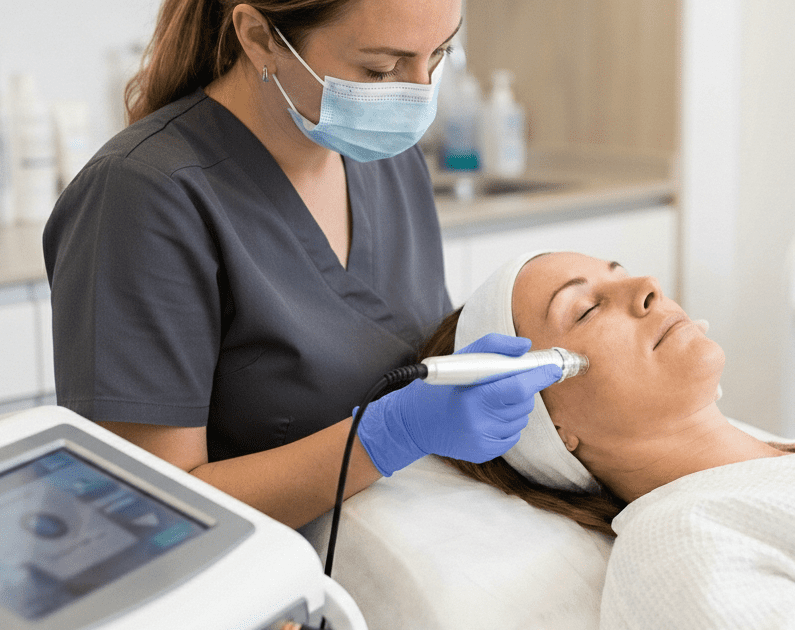
September often brings a change in perspective on skin. A tan may begin to fade, freckles or uneven pigmentation may look more noticeable, and texture that was easy to overlook during summer can suddenly become more apparent.
That does not mean summer has damaged your skin in a way that must be treated. It also does not mean September is automatically the right time for a procedure. For some people, consistent skin care and sun protection are enough. For others, fall becomes a useful time to ask whether professional treatment could address a specific concern.
Three options that frequently enter that conversation are intense pulsed light, traditional microneedling, and fractional carbon dioxide laser resurfacing. They are not interchangeable.
In simple terms, IPL primarily targets selected colors in the skin, microneedling creates controlled mechanical injuries that stimulate a healing response, and fractional CO2 laser removes and heats microscopic areas of skin for more intensive resurfacing. Which approach makes sense depends on what you want to address, your skin type, recent sun exposure, medical history, medications, tolerance for recovery, and examination by a qualified provider.
Vanished Aesthetics & Wellness offers several professional options within its skin treatment services in Bloomington. A consultation is important because the treatment that sounds most powerful is not necessarily the treatment that best matches a particular concern.
Why September Brings More Questions About Skin Treatments
Summer usually means more opportunities for ultraviolet exposure, even for people who are careful about sunscreen. Pigmented spots can become more noticeable after sun exposure, and a fading tan can make differences in skin tone easier to see.
This seasonal transition also matters when considering light and laser procedures. The American Academy of Dermatology recommends avoiding tanning before laser treatment and emphasizes sun protection before and after procedures because treating tanned or sunburned skin can increase the risk of burns and discoloration.[1]
The same principle applies to treatment planning more broadly. September may be a good month to start the conversation, but a provider may recommend waiting if your skin is still tanned, irritated, recently sunburned, or otherwise not ready for treatment.
There is no universal calendar date when skin becomes ready for IPL, microneedling, or resurfacing.
What Is IPL?
IPL stands for intense pulsed light. Although people commonly call it a laser treatment, IPL is technically different from a laser because it delivers a range of filtered light wavelengths rather than one single laser wavelength.
Selected wavelengths can be absorbed by melanin, which gives pigment its color, or hemoglobin, which gives blood its red color. That makes IPL useful for certain brown spots and vascular concerns in appropriately selected skin.
Published research supports IPL as an option for aspects of photoaging, including selected pigmentation and vascular changes, although studies vary in treatment protocols and outcome measures.[2]
At Vanished, IPL is part of the clinic’s broader advanced skin treatment menu.
IPL may be discussed for
IPL may be considered when the main concern is selected superficial brown pigmentation, diffuse redness, or visible small vessels.
The word selected matters. A brown patch is not automatically an IPL target. Pigmentation can have different causes, and some conditions, including melasma, may worsen with inappropriate light treatment. Suspicious pigmented lesions also need medical evaluation rather than cosmetic treatment.
What IPL does not do particularly well
IPL should not be thought of as a universal resurfacing procedure. If the primary concern is depressed acne scarring or more substantial texture irregularity, a provider may discuss another approach.
It also cannot guarantee that pigmentation will disappear or stay away. Additional ultraviolet exposure can contribute to new pigmentation over time.
What Is Traditional Microneedling?
Microneedling uses a device with fine needles to create controlled microscopic punctures in the skin. These injuries trigger a wound healing response that can gradually affect collagen organization and skin texture.
The FDA has authorized specific microneedling devices for defined uses that include improving the appearance of facial acne scars, facial wrinkles, and abdominal scars in adults aged 22 and older. Authorization applies to specific devices and intended uses, not to every microneedling device or every advertised application.[3]
Research reviews support microneedling as an option for selected acne scars, although protocols and results vary considerably among studies.[4]
Microneedling may be discussed for
Traditional microneedling may enter the conversation when a person is concerned about:
- Acne scarring
- Uneven texture
- Selected fine lines
- Certain scar related concerns
The goal is gradual remodeling, rather than immediately removing a visible layer of skin.
What should you expect after microneedling?
Temporary redness, tightness, dryness, roughness, peeling, bruising, pinpoint bleeding, or discomfort can occur. Less common complications can include infection, pigmentation changes, and reactivation of cold sores.[3]
The amount of recovery varies according to the device, depth, treated area, skin characteristics, and individual response.
That is why claims such as “zero downtime” are not appropriate.
Where Does RF Microneedling Fit?
Radiofrequency microneedling combines needle penetration with radiofrequency energy, which generates heat within tissue. It is more than simply a stronger version of traditional microneedling because the additional thermal energy changes both the intended tissue effect and the risk profile.
The FDA issued a safety communication in October 2025 after receiving reports of serious complications associated with certain uses of RF microneedling. Reported complications included burns, scarring, fat loss, disfigurement, and nerve damage.[5]
That does not mean every person who has RF microneedling will experience these complications. It does mean that RF microneedling deserves a separate risk discussion rather than being grouped casually with traditional microneedling.
Anyone considering RF microneedling should ask what device is being used, why it is being recommended for the specific concern, what experience the provider has with that device, and what alternatives are available.[5]
What Is Fractional CO2 Laser Resurfacing?
A carbon dioxide laser uses energy that is strongly absorbed by water in tissue. Fractional treatment creates many controlled microscopic treatment zones while leaving areas of surrounding tissue untreated.
The intensity can vary considerably.
Vanished lists Tetra fractional CO2 treatment and a lower thermal treatment approach commonly referred to as CoolPeel among its skin services. These should not be interpreted as identical experiences at every setting.
Fractional CO2 resurfacing can be considered for selected concerns involving texture, fine lines, photodamage, and certain scars. Research has supported fractional CO2 treatment for acne scarring, although studies vary in treatment settings, patient populations, and outcome measurements.[6]
Is CO2 laser stronger than microneedling?
“Stronger” is not a very useful way to choose treatment.
Fractional CO2 laser can create more intensive resurfacing than traditional microneedling, but that comes with different recovery considerations and risks. Depending on treatment intensity, redness, swelling, crusting, peeling, oozing, and prolonged pinkness may occur.
Potential complications include infection, reactivation of herpes virus, persistent redness, scarring, acne or milia, and changes in pigmentation.
A 2026 systematic review comparing fractional CO2 laser with needling based approaches for facial acne scars found substantial variation among studies and did not establish a simple universal winner for every patient or every scar pattern.[7]
That is exactly why an individualized examination matters.
IPL vs Microneedling vs CO2 Laser at a Glance
| Question | IPL | Traditional Microneedling | Fractional CO2 Laser |
| Main mechanism | Filtered light targets selected pigment or blood vessels | Fine needles create controlled mechanical injury | Laser creates microscopic areas of ablation and heat |
| Common discussion point | Brown spots and redness | Texture and selected scars | Texture, scars, fine lines, and resurfacing |
| Removes surface skin | Not primarily | No intentional ablation | Yes, depending on treatment settings |
| Typical intensity | Varies | Varies with depth and device | Can range from lighter to more intensive |
| Pigment considerations | Very important | Important | Very important |
| Recent tanning matters | Yes | Yes | Yes |
| Results guaranteed | No | No | No |
| Consultation needed | Yes | Yes | Yes |
This table is a general educational comparison, not a candidacy tool.
What About Sun Spots?
If your main concern after summer is a cluster of newly noticeable brown areas, the first question should not necessarily be, “Which machine removes them?”
The first question is, “What are these spots?”
Benign sun related pigmentation may sometimes respond to light or laser treatment, but pigmentation can also represent melasma, post inflammatory hyperpigmentation, or a skin lesion that needs medical evaluation.
The American Academy of Dermatology advises having an appropriate evaluation before cosmetic laser treatment and emphasizes the importance of matching treatment to the individual skin concern and skin type.[1]
A cosmetic appointment should never substitute for medical evaluation of a spot that is changing, bleeding, itching persistently, developing unusual borders, or otherwise concerning.
What About Acne Scars and Uneven Texture?
Texture concerns are where microneedling and fractional laser resurfacing often overlap.
A 2024 network meta analysis of randomized trials found evidence supporting microneedling and combination approaches for acne scars, but treatment results differed according to modality and study design.[4]
Newer comparative evidence also illustrates why blanket statements should be avoided. Research comparing fractional CO2 laser with needling based treatments includes substantial differences in scar type, treatment settings, skin characteristics, and study methodology.[7]
Two people who both say, “I have acne scars,” may therefore receive very different recommendations.
Scar depth, scar shape, pigmentation risk, active acne, previous treatment, skin type, expectations, and acceptable recovery all matter.
Does Skin Tone Affect the Decision?
Yes.
Melanin absorbs light and influences the risk of unwanted pigmentation changes after some procedures. The AAD notes that people with darker skin can have an increased risk of burns and dark marks after laser treatments, which makes appropriate device selection, treatment settings, and provider expertise especially important.
Microneedling also has pigmentation considerations. The FDA specifically notes that some authorized microneedling devices were not studied in people with darker skin types and that changes in pigmentation can occur.
This does not mean a particular skin tone automatically rules a treatment in or out. It means skin type should be part of the risk assessment rather than an afterthought.
Who Needs Medical Review Before Treatment?
Professional skin procedures are not appropriate for everyone at every moment.
A provider may need to review active acne or infection, current rashes, recent tanning, pregnancy, medications, bleeding risk, immune suppression, history of abnormal scarring, cold sores, recent resurfacing procedures, suspicious lesions, and conditions that affect healing.
Microneedling, IPL, and fractional CO2 treatment also have different device specific precautions.
Rather than trying to determine candidacy from an online checklist, bring a current medication and supplement list and tell your provider about previous procedures, reactions, pigmentation problems, medical conditions, and your realistic tolerance for recovery.
Which Treatment Has the Least Downtime?
There is no responsible fixed answer.
IPL frequently involves redness, swelling, or temporary darkening and crusting of treated brown spots.
Microneedling can cause redness, swelling, tightness, dryness, roughness, pinpoint bleeding, and temporary sensitivity.[3]
Fractional CO2 resurfacing may involve considerably more visible healing depending on the treatment intensity. Lower intensity approaches can reduce recovery compared with more aggressive resurfacing, but “lower downtime” should not be translated into “no downtime.”
Your personal calendar matters. If you have a wedding, photography session, presentation, travel, or another important event coming up, tell the provider during consultation rather than assuming an internet recovery estimate will apply to you.
September Treatment Planning Should Start With the Concern
Instead of beginning with a device name, begin with the change you actually want to understand.
If the issue is brown pigmentation, ask whether the pigment has been properly identified and whether IPL or another approach is appropriate.
If it is persistent redness, ask what is causing the redness and whether a vascular light treatment makes sense.
If it is acne scarring or irregular texture, ask how traditional microneedling compares with laser resurfacing for your particular scar pattern.
If it is fine lines plus more substantial textural change, ask about the tradeoff between treatment intensity, potential improvement, recovery, and risk.
And if your skin simply seems a little dull or dry after summer, an advanced procedure may not be necessary at all.
Frequently Asked Questions
Is September the best month for IPL?
Not automatically. September can be a useful time for an evaluation as summer sun exposure decreases for many people, but recent tanning and ongoing sun exposure are still important. Your provider should assess your current skin before treatment.
Can IPL remove sun spots permanently?
IPL may improve selected brown spots, but complete or permanent clearance cannot be promised. Future sun exposure and the underlying biology of pigmentation can affect recurrence or the development of new spots.
Is microneedling better than IPL?
They address different concerns. IPL is generally used to target selected pigment and vascular changes. Microneedling creates controlled mechanical injury and is more often discussed for texture and selected scars. Neither is universally better.
Is CO2 laser better than microneedling for acne scars?
Research supports both approaches, and comparative studies do not justify a universal answer for every scar or patient.[7] Scar type, skin type, pigmentation risk, desired intensity, and recovery preferences all influence treatment planning.
Does microneedling have downtime?
Yes, although the amount varies. Redness, tightness, dryness, peeling, bruising, bleeding, crusting, and sensitivity can occur.[3]
Is RF microneedling the same as regular microneedling?
No. RF microneedling combines needles with radiofrequency heat. The FDA has reported serious complications with certain uses, including burns, scarring, fat loss, disfigurement, and nerve damage.[5]
Can I have IPL while I still have a tan?
Recent tanning can increase treatment risk. The AAD advises avoiding tanning before laser and light based treatment because a tan or sunburn can increase the risk of burns or discoloration.[1] Your provider should determine when your skin is ready.
Can darker skin tones have these treatments?
Potentially, but device selection, settings, diagnosis, and provider experience are especially important because pigment changes can occur. A consultation is necessary rather than relying on a broad claim that one procedure is appropriate for every skin tone.
How many treatments will I need?
There is no reliable universal number. The treatment, concern, intensity, skin response, and desired endpoint all matter. A provider should discuss a treatment plan after examining your skin.
What should I ask during a consultation?
Ask what the provider believes is causing the concern, why a specific treatment is being recommended, which device will be used, what alternatives exist, what recovery may look like, what complications are possible, and what would make the provider postpone or avoid treatment.
A More Useful Fall Skin Plan Starts With an Assessment
IPL, traditional microneedling, RF microneedling, and fractional CO2 resurfacing can all have a role in professional skin care, but they solve different problems and carry different tradeoffs.
September does not create an automatic treatment window. It creates a useful opportunity to look at your skin after summer and decide whether anything actually needs to change.
If pigmentation, redness, acne scars, texture, or fine lines are bothering you, a consultation at Vanished Aesthetics & Wellness in Bloomington can help clarify what you are seeing, which options may be reasonable, and whether waiting or choosing a simpler approach makes more sense. Explore the clinic’s current skin treatment options before your visit, then confirm current availability and individualized recommendations with the clinical team.