
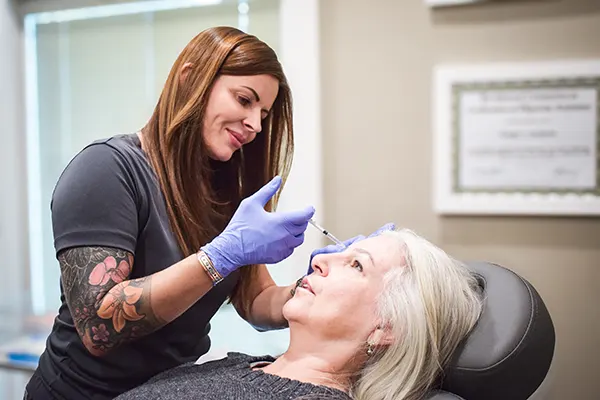
The skin-care routine that worked well in your 20s and 30s may feel less effective or suddenly too aggressive by the time you reach your 40s or 50s.
A cleanser that once left your skin feeling refreshed may now cause tightness. Products you used regularly may begin to sting. Fine lines, uneven tone, redness, rough texture, and brown spots can become more visible. Some women also experience the frustrating combination of breakouts and dryness at the same time.
These changes do not mean your skin is unhealthy or that you need to “correct” normal aging. They do suggest that your routine and treatment priorities may need to evolve.
Chronological aging, cumulative ultraviolet exposure, genetics, medications, health conditions, stress, environmental factors, and hormonal changes can all influence how skin looks and feels. During perimenopause and menopause, changing hormone levels may contribute to increased dryness, thinning, and reduced elasticity, although the experience differs from person to person.[1][2] (American Academy of Dermatology)
A thoughtful approach begins with understanding your main concerns, not buying the largest possible collection of products or immediately choosing the most intensive procedure.
Why Does Skin Change in Your 40s and 50s?
Skin aging is gradual. It involves changes in surface-cell turnover, moisture retention, collagen organization, oil production, healing, pigmentation, and the tissues beneath the skin.
Years of ultraviolet exposure can also make age spots more visible during middle age. This accumulated sun-related change, known as photoaging, may contribute to wrinkles, roughness, uneven pigmentation, and reduced elasticity. The American Academy of Dermatology considers sun protection a foundation of skin care in the 40s and 50s.[1] (American Academy of Dermatology)
Perimenopause and menopause may add another layer. Estrogen has roles in skin hydration, collagen, elasticity, and barrier function. As hormone levels change, some women notice that their skin becomes drier, thinner, or more sensitive.[2] (American Academy of Dermatology)
Hormonal change is not the only possible explanation for a new skin concern. Persistent rashes, painful breakouts, suspicious spots, or sudden changes deserve appropriate medical evaluation rather than automatic attribution to menopause.
Six Common Middle-Age Skin Challenges
1. Dryness and a More Sensitive Skin Barrier
Dryness may appear as tightness, flaking, itching, roughness, or increased sensitivity to products. It may become especially noticeable around the cheeks, mouth, and eye area.
A common mistake is continuing to use the same combination of foaming cleansers, scrubs, exfoliating acids, and retinoids even when the skin no longer tolerates them. Using too many active products can disrupt the skin barrier and make dryness or burning worse.
A basic routine may include:
- A gentle cleanser
- A fragrance-free moisturizer suited to current tolerance
- Broad-spectrum sunscreen with SPF 30 or higher
- Gradual introduction of any additional active products
For women looking for temporary surface hydration or smoothing, HydraFacial and facial treatments may be discussed during a consultation. These treatments can include cleansing, controlled exfoliation, suction-assisted removal of surface debris, masks, serums, or other customized steps.
A facial may help skin feel smoother or more hydrated temporarily, but it does not permanently change the biological causes of dry skin. Product ingredients, sensitivities, allergies, medications, active skin conditions, and recent procedures still matter.
2. Dullness and Rough Surface Texture
Skin may look less reflective or feel rougher when surface cells do not shed evenly. Dehydration, irritation, accumulated sun exposure, and product buildup can all contribute.
Professional options vary in intensity:
HydraFacial-style treatments focus on cleansing, exfoliation, suction, and topical hydration.
Customized facials may use enzymes, masks, extractions, or provider-selected products.
Dermaplaning mechanically removes surface cells and fine vellus hair, sometimes called “peach fuzz,” to create temporary smoothness.
Chemical treatments use acids or other active ingredients to produce controlled exfoliation or stimulation.
Vanished offers several skin-treatment options including facials, dermaplaning, chemical peels, microneedling, light-based procedures, and laser resurfacing. These categories are not interchangeable. A gentle facial intended for hydration is very different from a chemical peel or fractional laser procedure.
Even a treatment marketed as producing little visible peeling may cause redness, stinging, dryness, flaking, or pigment changes. “Minimal downtime” should never be interpreted as guaranteed zero reaction.
3. Brown Spots, Pores, Redness, and Uneven Tone
Past sun exposure often becomes more apparent in middle age. Brown spots, uneven pigmentation, redness, or visible vessels may become more noticeable even when they develop gradually.
Daily sun protection remains important before and after any professional treatment. Sunscreen cannot erase every existing spot, but it can reduce additional ultraviolet exposure and help protect treatment results.[1][2] (American Academy of Dermatology)
Depending on the exact concern, professional options may include a chemical peels, intense pulsed light, or a laser procedure.
Intense pulsed light, commonly called IPL, delivers filtered broad-spectrum light. It may be considered for selected superficial brown or red targets after the provider evaluates the skin tone, diagnosis, tanning history, medications, and pigment risk.
Not every brown area should be treated as a sun spot. Melasma, post-inflammatory pigmentation, freckles, and suspicious lesions require different approaches. IPL can worsen certain pigment conditions and can cause burns or unwanted lightening or darkening.
A spot that is new, changing, irregular, bleeding, repeatedly crusting, or failing to heal should be medically examined before cosmetic treatment.
4. Fine Lines and Changes in Firmness
Fine lines and changes in firmness do not result from a single process. Sun exposure, repeated facial movement, collagen changes, genetics, smoking, hydration, and changes in facial fat, muscle, and bone can all play a role.
Surface-level facials may temporarily improve hydration and make fine lines look less noticeable, but they do not reproduce the effects of a procedure intended to create deeper remodeling.
Options discussed within advanced aesthetics may include traditional microneedling, radiofrequency microneedling, and fractional laser resurfacing.
Traditional Microneedling
Traditional microneedling uses small needles to create controlled micro-injuries. The healing response may gradually improve selected acne scars, wrinkles, and textural concerns.
The FDA has legally authorized specific microneedling devices for defined indications, including improving the appearance of certain facial acne scars, facial wrinkles, and abdominal scars in adults aged 22 or older. Authorization applies to the exact device and indication—not every microneedling pen, treatment mixture, body area, or marketing claim.[4] (U.S. Food and Drug Administration)
Possible effects include redness, swelling, pinpoint bleeding, dryness, temporary roughness, infection, herpes reactivation, pigment changes, scarring, or reactions to substances applied to freshly treated skin.
RF Microneedling
Radiofrequency microneedling combines needles with controlled thermal energy. It can be more intensive than traditional microneedling and may be discussed for selected texture, scar, wrinkle, or mild-laxity concerns.
The FDA has warned about reports of serious complications associated with certain uses of RF microneedling, including burns, scarring, fat loss, disfigurement, and nerve damage.[5] (U.S. Food and Drug Administration)
This does not mean every patient will experience a serious complication. It does mean RF microneedling should not be presented as risk-free, appropriate for everyone, or simply a stronger facial. Device selection, treatment depth, energy, anatomy, skin type, operator training, and aftercare all matter.
Fractional CO2 Resurfacing
Fractional CO2 laser treatment creates controlled microscopic areas of ablation and heat. Depending on treatment intensity, it may be considered for selected wrinkles, photodamage, scars, or textural concerns.
Lighter CoolPeel-style settings may involve less recovery than aggressive CO2 resurfacing, but they are not zero-downtime treatments. Redness, swelling, dryness, crusting, prolonged pinkness, infection, herpes reactivation, scarring, and pigment changes remain possible.
The most intensive treatment is not automatically the best treatment. A stronger procedure generally brings a different recovery experience and risk profile.
5. Adult Acne Alongside Dryness
Acne can continue or first appear during the 40s and 50s. Hormonal fluctuations may be one factor for some women, but products, medications, stress, occlusion, and underlying skin conditions can also contribute.[3] (American Academy of Dermatology)
Adult breakouts may occur around the chin and jawline while the cheeks or eye area remain dry. Treating the entire face as excessively oily can worsen irritation.
It is also important to confirm that the bumps are acne. Rosacea, perioral dermatitis, folliculitis, contact reactions, and other conditions can look similar.
Customized facials or selected chemical treatments may complement an acne-care plan for some people, but they do not replace medical evaluation of painful, cystic, scarring, sudden, or treatment-resistant acne.
6. Less Predictable Product and Treatment Tolerance
A procedure or product you tolerated years ago may not feel the same today. Hormonal changes, a weakened barrier, medications, recent procedures, medical conditions, and cumulative sun damage can affect recovery and sensitivity.
This is one reason to avoid “stacking” several new treatments at once. Combining strong exfoliation, retinoids, peels, lasers, and microneedling without a coordinated plan can increase irritation and make it difficult to identify the cause of a reaction.
Before a professional procedure, the provider may need to review:
- Current skin-care products and prescriptions
- Allergies and prior reactions
- History of cold sores
- Tendency toward dark marks or scarring
- Recent sun exposure or tanning
- Previous laser, peel, injectable, or needling treatments
- Pregnancy or breastfeeding
- Medical conditions and medications that affect healing
An online guide cannot determine candidacy.
A Practical At-Home Routine
A useful routine does not need ten steps.
Morning
Use a gentle cleanser or rinse with water if twice-daily cleansing worsens dryness. Follow with moisturizer as needed and broad-spectrum sunscreen with SPF 30 or higher. Shade, hats, protective clothing, and sunglasses provide additional protection.[1][2] (American Academy of Dermatology)
Evening
Remove makeup and sunscreen gently. Apply moisturizer while the skin is still slightly damp if that improves comfort.
Products such as retinoids, exfoliating acids, pigment ingredients, or acne treatments may be useful for specific concerns, but introducing several at once can cause unnecessary irritation. Begin according to skin tolerance and seek professional guidance for prescription products or persistent concerns.
When Skin Feels Irritated
Temporarily simplify the routine. Pause unnecessary scrubs and exfoliants, use gentle cleansing and moisturizer, and continue sun protection when tolerated.
Persistent burning, swelling, cracking, rash, or worsening redness should be evaluated rather than repeatedly treated with additional active products.
Matching a Concern to a Treatment Category
| Primary concern | Categories that may be discussed | Important limitation |
| Temporary dehydration or dullness | HydraFacial or customized facial | Results are generally temporary |
| Fine facial hair and surface roughness | Dermaplaning | Does not treat deeper wrinkles or scars |
| Superficial texture or selected pigmentation | Chemical treatments | Depth, skin type, pigment history, and aftercare affect risk |
| Acne scars or textural irregularity | Traditional microneedling | Usually involves temporary redness and gradual change |
| Texture with mild-laxity concerns | RF microneedling | More intensive; serious complications have been reported |
| Selected brown spots or redness | IPL | Not appropriate for every skin tone or pigment condition |
| More involved resurfacing goals | Fractional CO2 or CoolPeel-style treatment | Downtime and risk vary with treatment intensity |
This table is educational. It cannot identify the best procedure for an individual person.
When Cosmetic Treatment Should Wait
A cosmetic service should not delay an evaluation of a possible skin disorder.
Seek medical or dermatologic assessment for:
- A new or changing mole
- A spot that bleeds or does not heal
- Sudden, painful, cystic, or scarring acne
- Persistent rash, burning, or unexplained swelling
- Signs of infection
- A severe or unusual reaction to a product
- Symptoms that began after starting a medication
- A possible eczema, rosacea, psoriasis, or skin cancer concern
Building a Skin Plan in Bloomington
A useful consultation should begin with your concern rather than a predetermined procedure.
At Vanished Aesthetics & Wellness, the discussion may include your current routine, sensitivity, medical history, medications, prior procedures, skin tone, pigment history, downtime preferences, and goals.
The result may be a recommendation for a lower-intensity facial, a gradual series of treatments, a more involved resurfacing procedure, a simplified home routine, or referral for medical evaluation. It is also possible that no procedure is appropriate at the time.
Skin changes in the 40s and 50s are not flaws that must be treated. Professional care is an option when a concern bothers you and the expected benefits, limitations, recovery, and risks fit your priorities.
To discuss current options, contact Vanished Aesthetics & Wellness for an individualized consultation in Bloomington, Indiana.
Frequently Asked Questions
What is the best skin-care routine for women in their 40s and 50s?
A reliable foundation generally includes gentle cleansing, moisturizer, and daily broad-spectrum sunscreen with SPF 30 or higher. Additional products should address a defined concern and be introduced according to skin tolerance.[1][2]
Why has my skin become dry in my 40s?
Dryness may reflect normal aging, hormonal changes, weather, over-cleansing, medications, frequent exfoliation, or a skin condition. Persistent itching, cracking, burning, or rash warrants evaluation.[2]
Can menopause cause acne and dry skin at the same time?
Yes. Some women experience adult acne while other areas become dry or sensitive. Hormones may contribute, but other causes should also be considered.[2][3]
Is microneedling the same as RF microneedling?
No. Traditional microneedling creates controlled mechanical punctures. RF microneedling also delivers thermal energy and has a different treatment and risk profile.[4][5]
Does a HydraFacial build collagen?
HydraFacial is primarily a surface-level cleansing, exfoliation, suction, and hydration treatment. It should not be presented as equivalent to a deeper collagen-remodeling procedure.
Does CoolPeel have zero downtime?
No procedure should be described as having guaranteed zero downtime. Lighter CO2 settings may reduce visible recovery, but redness, dryness, swelling, pigment changes, and other complications remain possible.
Are professional treatments appropriate for every skin tone?
No. Safety depends on the exact treatment, device, settings, diagnosis, current tan, pigment history, and provider assessment.
How do I know which skin treatment I need?
A provider must examine the skin and review medical history, medications, prior procedures, sensitivities, goals, and tolerance for downtime. An article cannot determine candidacy.
References
[1] American Academy of Dermatology. “Skin Care in Your 40s and 50s.” Guidance on foundational skin-care habits and sun protection. (American Academy of Dermatology)
[2] American Academy of Dermatology. “Caring for Your Skin in Menopause.” Guidance on dryness, thinning, sensitivity, and menopause-related skin changes. (American Academy of Dermatology)
[3] American Academy of Dermatology. “Adult Acne.” Information on acne continuing or developing during adulthood, including the 40s and 50s. (American Academy of Dermatology)
[4] U.S. Food and Drug Administration. “Microneedling Devices.” Current legally authorized uses, limitations, and general risks. (U.S. Food and Drug Administration)
[5] U.S. Food and Drug Administration. “Potential Risks With Certain Uses of Radiofrequency Microneedling: FDA Safety Communication.” October 15, 2025. (U.S. Food and Drug Administration)